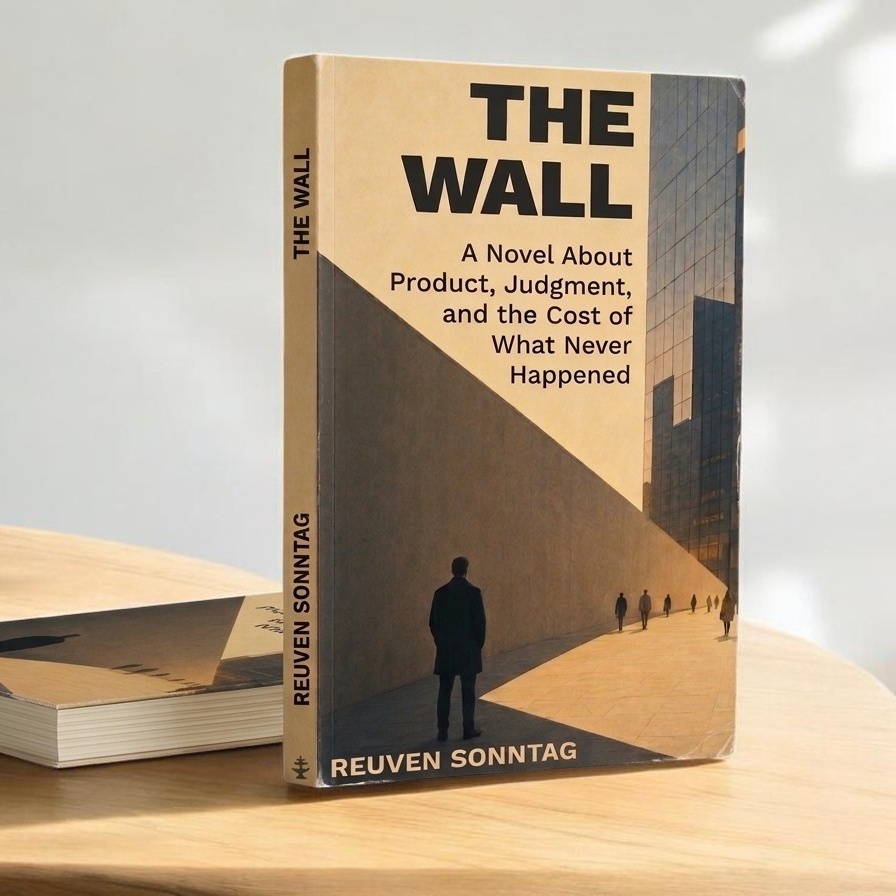
From The Wall · An Excerpt
The Wall
A Novel About Product, Judgment, and the Cost of What Never Happened
by Reuven Sonntag
This was two years before everything came apart, in the good days, when we still believed. Eitan and Yossi had built a travel companion, a voice in your pocket that planned your journey the way a brilliant friend would, if that friend had read everything and forgotten nothing and wanted only your happiness. They had given it a name, Juno, the way you name a thing you love.
The day I want to tell you about, we were showing Juno to a woman named Claire, who bought travel tools for a company that sent four thousand people a year around the world. She told us before we began that she had seen every travel app ever made, and been impressed by precisely none, and she said it in the dry, faintly tired voice of a woman who had learned to enjoy being unimpressed, who had made a small professional art of it. She watched the start of the demo with her arms folded, the way you fold your arms at a thing that is going to have to earn it.
Eitan asked her where she was going next, herself, personally, and she said Nashville, the long Fourth of July weekend, the first proper break she had taken in a year and one she had not yet had the time to think about. And he said, may we, and she shrugged, and he fed Juno the bones of it, the dates, the holiday, the three days she had to herself, and three things Claire had let slip in the small talk before we began: that she had a bad knee, that she had loved old bluegrass since she was nineteen, and that she was, her word, peopled-out by the end of a working week.
And Juno thought for a moment, and then it built her the Fourth.
It did not give her a list of the ten best things to do in Nashville. It gave her a single quiet day that seemed to have been made by someone who knew her. It started late, because she would be tired. It kept her off the long crowded crawl down Broadway, because of the knee, and because of the crush, and it said so gently, without making a thing of it. It put a slow lunch in a quiet place off the tourist streets in the dead heat of the early afternoon, when she would want to be peopled-out alone. In the evening, when she would have her appetite for the world back, it had found an old picker in the back room of a bar a few miles from the noise, a man she had never heard of but would love, playing the kind of bluegrass she had loved since she was nineteen, that night only, because Juno had checked. And late, for the fireworks, it did not send her into the hundred thousand people down on the riverfront. It sent her to a quiet hill on the far side of the water, with the whole city and its fireworks laid out in front of her and almost no one else around, because from one offhand word it had understood exactly the kind of Fourth of July she actually wanted.
The room went quiet. Claire looked at her phone for a while, and at some point the arms came unfolded, and for a moment she forgot to be the woman who was unimpressed by everything. Her eyes were not the eyes of a woman evaluating a piece of software. They were the eyes of a woman who had been seen.
“How did it know about the bluegrass,” she said, quietly, and Eitan grinned like a boy, because that was his favourite part, the part where people stopped asking what it did and started asking how it knew them.
And then she put herself back together, almost at once. You could watch it happen, the professional sliding back over the person, the arms refolding, the dry distance returning to her face, as though she had caught herself believing in something and found it a little embarrassing.
He showed her the other things after that, because he could not help himself. First he tried to show her Juno on a harder trip than Nashville, a late arrival in a city on the far side of the world, the kind of place he liked to prove her on. For a moment the magic caught, and then it stalled, because the train times and the bus times in a place like that reached Juno as a swamp, every country its own separate mess, and the beautiful thing sat there a second, not sure how a tired stranger was meant to get from the airport to the bed. Eitan waved it off before Claire could dwell on it. That part was nobody's idea of the future, he said. Just plumbing. Everybody's was broken, and they would get to it. I believed him, the way everybody believed him about the boring half of the world.
Then he showed her how Juno watched your flights while you slept. If the world broke in the night, it would put the trip back together before you woke, rebook the cancelled connection, push the hotel, move the car, and have the whole thing waiting for your yes in the morning. Claire said that was clever too. But it was the Fourth she kept coming back to. Nobody falls in love with the part that fixes what goes wrong. They fall in love with the part that dreams.
She did not leave glowing. Glowing was not in her register. But she told us, on her way out, that it was the most impressive thing she had seen in ten years in the business, and from her, a woman who enjoyed being unimpressed, that was very nearly a confession, and she shook Eitan's hand with both of hers, which I think surprised her rather more than it surprised us. And then she went back to her company that sent four thousand people a year around the world, and she did not buy it.
Not that day, and not the next month, and not ever.
Want to know why? The Wall follows one product manager's slow, costly discovery of the difference between the thing people love and the thing people need — and what it costs to tell the two apart before it's too late.